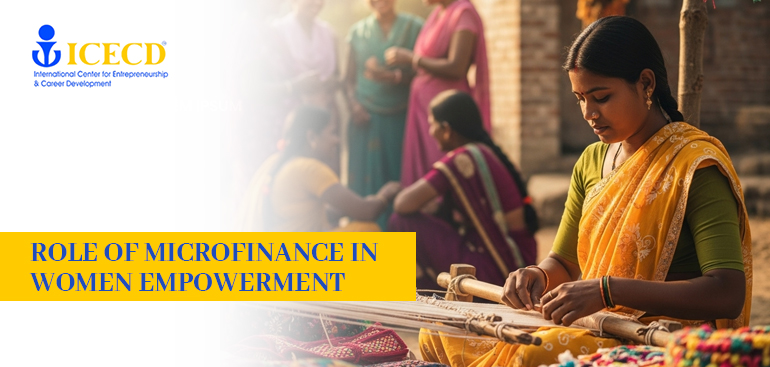
In India’s journey toward inclusive development, one of the most transformative tools for empowering women in rural and semi-urban areas has been microfinance. By providing small, collateral-free loans and financial services, microfinance has become a powerful instrument for boosting economic independence, decision-making power, and social mobility among women.
Let’s explores the role of microfinance in women empowerment, its impact, and challenges for fostering women-led growth through financial inclusion.
What is Microfinance?
Microfinance refers to a range of financial services—including microcredit, savings, insurance, and financial training—provided to low-income individuals or groups, primarily women, who do not have access to traditional banking.
Unlike conventional loans, microfinance:
- Does not require collateral
- Has smaller loan amounts (often ₹5,000–₹50,000)
- Offers flexible repayment terms
- Is typically disbursed through Self-Help Groups (SHGs) or Microfinance Institutions (MFIs)
Why Microfinance for Women?
Women—especially in rural India—face multiple barriers to economic participation, including lack of property rights, limited financial literacy, and cultural restrictions. Microfinance addresses these barriers by:
- Offering capital to start or expand small businesses
- Encouraging savings habits
- Fostering financial independence
- Building leadership skills and confidence
In fact, women borrowers show higher repayment rates and community commitment, making them ideal beneficiaries of microfinance programs.
1. Economic Independence and Income Generation
Access to microcredit allows women to launch home-based or micro businesses in areas like trading, manufacturing and services in various sectors like textile and garment, ladies accessories, food, lunch dabba services, catering, etc. This provides a steady income, reduces dependency on male family members, and improves overall household welfare.
2. Improved Decision-Making Power
When women earn and contribute to the family income, they gain greater say in household decisions—from children’s education to healthcare and investments. Financial contribution leads to social respect and recognition, both within and outside the family.
3. Boost in Self-Confidence and Social Status
Handling money, running a business, and participating in SHG meetings build confidence, leadership, and negotiation skills among women. Many become role models and community leaders, actively participating in local governance and village development.
4. Education and Health Outcomes
With improved income, families can afford better nutrition, healthcare, and education for their children, especially daughters. Women are more likely to invest in their family’s well-being, creating a multiplier effect for future generations.
5. Promotion of Women-Led Enterprises
Microfinance encourages women to think beyond livelihood and build scalable enterprises. With additional support like business training, digital literacy, and market linkage, many women turn into full-fledged entrepreneurs.
ICECD plays a vital role in this transition by offering:
- Capacity-building programs
- Financial literacy training
- Entrepreneurial mentoring
- Product development and branding support
Challenges Faced by Women in Accessing Microfinance
While microfinance has created remarkable impact, several structural challenges still exist:
| Challenge | Description |
| Limited Awareness | Many women are unaware of loan facilities and their rights |
| Documentation Barriers | Lack of ID proof, bank accounts, or digital access |
| Low Financial Literacy | Inability to calculate profit/loss, interest, or cash flow |
| Social Norms | Male dominance or family restrictions on business ownership |
| MFI Limitations | High interest rates or poor service quality in some regions |
- Programs led by ICECD aim to address these gaps by offering holistic support beyond just capital access.
The Role of SHGs and Microfinance Institutions
1. Self-Help Groups (SHGs)
SHGs are small groups (usually 10–20 women) that promote savings and mutual lending. They:
- Create financial discipline
- Build peer support systems
- Enable collective business efforts
- Improve creditworthiness for bank loans
2. Microfinance Institutions (MFIs)
MFIs act as intermediaries that provide microloans and sometimes offer training and insurance.
Collaborations between SHGs, MFIs, and institutions like ICECD amplify impact and create sustainable models for women’s empowerment.
Impact on the Ground
ICECD has been at the forefront of empowering rural women through its Women Entrepreneurship Development Programmes. As a leading NGO for women empowerment in India, this initiative focuses on developing entrepreneurial competencies among women in rural and semi-urban areas, helping them build small businesses based on their existing skills and local resources.
How Microfinance Supports Sustainable Development Goals (SDGs)
Microfinance directly contributes to achieving multiple UN Sustainable Development Goals, including:
- Goal 1: No Poverty
- Goal 5: Gender Equality
- Goal 8: Decent Work and Economic Growth
- Goal 10: Reduced Inequalities
By empowering women economically, microfinance creates ripple effects that uplift entire communities and ensure inclusive, resilient growth.
Also read: 17 Sustainable Development Goals
Conclusion
The role of microfinance in women empowerment is clear—it equips women with the tools to earn, lead, and transform their communities. But microfinance alone is not enough. Real change happens when financial access is combined with education, skill development, and ongoing support.
ICECD makes a difference—trains women to become not just borrowers, but confident, capable entrepreneurs who shape the future of rural India.
Want to empower yourself or your community?
Explore ICECD’s specialized programs in Sustainable Development and Rural Development Management Programmes to learn how financial tools like microfinance can help you or others start a journey toward independence and impact.
Also read: Three Pillars of Sustainable Development