In a world grappling with climate change, resource scarcity, and growing inequality, sustainable development has emerged as a guiding principle for lasting progress. But what makes development truly sustainable?
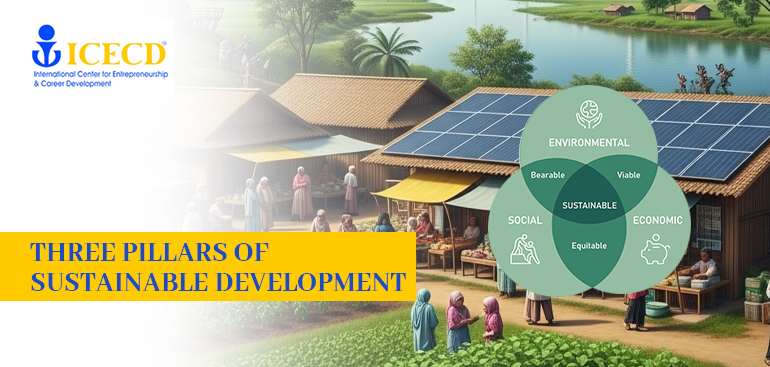
The answer lies in the three pillars of sustainable development: Environmental, Social, and Economic (ESG). These pillars form the foundation of sustainability and are crucial to building a world that is just, prosperous, and capable of sustaining future generations.
Let’s explore each of the three pillars of sustainability in detail and understand how they interconnect to form a holistic, future-ready model of development.
What Are the Three Pillars of Sustainable Development?
Sustainable development stands on three equally important pillars:
- Environmental Sustainability
- Social Sustainability
- Economic Sustainability
Together, these pillars help ensure that development is balanced—not just profitable or people-focused, but also planet-conscious. Ignoring even one of these pillars can lead to short-term gains but long-term problems.
1. Environmental Sustainability
Environmental sustainability focuses on preserving the natural world—our air, water, soil, forests, biodiversity, and climate. It ensures that human activities do not deplete or permanently damage natural resources.
Key Elements:
- Conservation of natural ecosystems and wildlife
- Responsible resource consumption
- Pollution control and waste management
- Climate change mitigation (reducing greenhouse gas emissions)
- Renewable energy use (solar, wind, hydro, etc.)
Why It Matters:
Without a healthy environment, life on Earth becomes unsustainable. Deforestation, rising temperatures, and water shortages are all results of poor environmental planning. A sustainable future requires us to restore ecosystems, reduce carbon footprints, and transition to green technologies.
2. Social Sustainability
Social sustainability is about creating inclusive, safe, and fair societies where every individual has access to basic rights, opportunities, and a high quality of life.
Key Elements:
- Access to education and healthcare
- Gender equality and social inclusion
- Labor rights and fair wages
- Community empowerment and participation
- Cultural preservation and human rights protection
Why It Matters:
A truly sustainable world uplifts people—not just economically but emotionally, culturally, and socially. Social sustainability focuses on reducing inequality, supporting vulnerable groups, and ensuring that development reaches the grassroots.
3. Economic Sustainability
Economic sustainability is the ability to support long-term economic growth without negatively impacting social or environmental well-being. It promotes development strategies that are stable, inclusive, and resource-efficient.
Key Elements:
- Ethical business practices and green innovation
- Job creation and poverty reduction
- Investment in sustainable infrastructure
- Entrepreneurship and skill development
- Circular economy and responsible production
Why It Matters:
An economy that thrives at the cost of nature or society is bound to collapse. Economic sustainability ensures that growth is inclusive, responsible, and future-oriented, creating decent work opportunities and reducing dependency on non-renewable resources.
Also read: 17 Sustainable Development Goals
Interconnection Between the Three Pillars
While each pillar has its own focus, they are deeply interconnected. One cannot exist in isolation:
- A booming economy (economic) that pollutes rivers (environmental) or exploits labor (social) is not sustainable.
- An eco-friendly policy that ignores job creation will fail to gain public support.
- Social programs without economic backing or environmental foresight may not survive in the long term.
True sustainability lies in the balance—where people, planet, and profit grow together.
Real-World Examples of the Three Pillars in Action
| Sector | Environmental | Social | Economic |
| Renewable Energy | Reduces carbon emissions | Creates green jobs | Promotes energy independence |
| Sustainable Agriculture | Conserves soil and water | Supports rural farmers | Increases long-term crop yields |
| Urban Planning | Reduces urban heat islands | Provides affordable housing | Boosts local economies |
ICECD is actively applying these principles to uplift rural communities, train women entrepreneurs, and support sustainable livelihoods across India and beyond.
Why Understanding These Pillars Is Important
Whether you’re a policymaker, business owner, student, or community leader, understanding these three pillars empowers you to:
- Make informed, sustainable decisions
- Support policies and projects with long-term value
- Advocate for balance between growth and responsibility
- Contribute to the global vision of the UN Sustainable Development Goals (SDGs)
How ICECD Supports the Three Pillars
The International Centre for Entrepreneurship and Career Development (ICECD) integrates the three pillars in all its initiatives. From grassroots entrepreneurship and vocational training to gender equality and climate-conscious practices, ICECD equips individuals with the knowledge and skills to build sustainable communities and resilient economies.
Through courses like the Certificate Course in Sustainable Development, ICECD ensures that the next generation of leaders and changemakers are equipped to create meaningful, lasting change.
Conclusion
The three pillars of sustainable development—environmental, social, and economic—serve as a powerful guide to building a better world. Only when all three are nurtured together can we achieve true sustainability that benefits both people and the planet.
At ICECD, we believe that development must be inclusive, responsible, and future-ready. Let’s commit to creating a world where growth doesn’t come at the cost of nature or humanity, but supports both—today and for generations to come.
Want to create sustainable change in your community?
Join ICECD’s Certificate Course in Sustainable Development—a 6-week online program designed to help you understand and apply the core principles of sustainability in real-world settings. Apply now for the course.
Also read:
What are the 5 Objectives of Rural Development?
Course: